



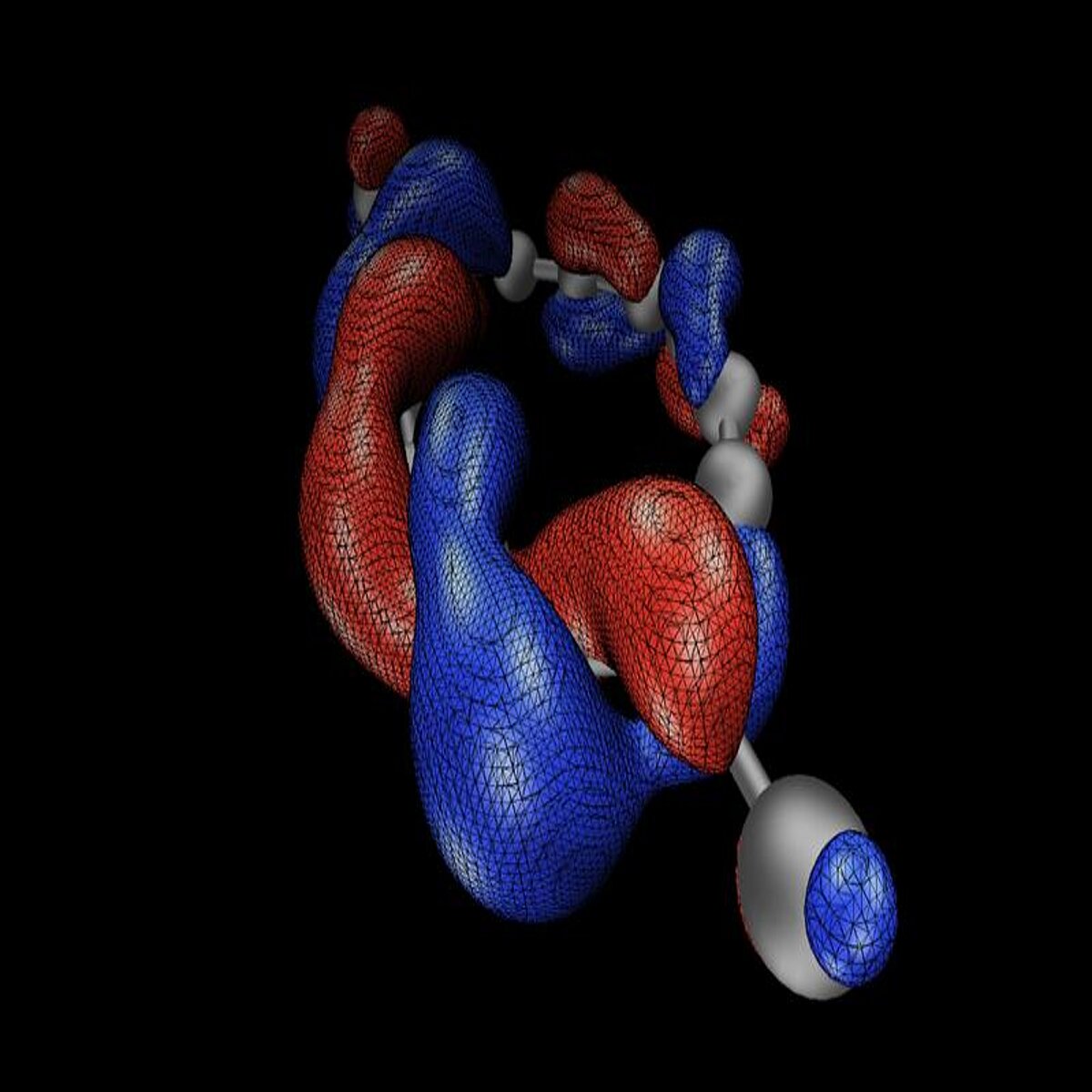
Dyson orbital for electron attachment, calculated using quantum hardware. IBM Research and the University of Manchester.
Researchers at IBM Research, the University of Manchester, Oxford University, ETH Zürich, EPFL Lausanne and the University of Regensburg (Cluster of Excellence CCE) collaborated to realize an unprecedented molecular topology: the so-called half-Möbius topology. Using atom manipulation with a scanning probe microscope, the researchers created an exotic molecule, that is C13Cl2, with a helical electronic structure that is qualitatively different from all previously known molecules.
C13Cl2 forms a molecular ring, adopting a chiral geometry, that is, a geometry having a handedness. Its electrons can extend over the entire ring, something quite common in organic molecules. What matters here is, how the electron cloud is connected, when going around the ring. In Möbius molecules the electron cloud can form a loop with a half-twist, like a ribbon twisted once before joining its end, as in a Möbius strip. In C13Cl2 it is even more intricate: the electron cloud half-twists after two complete loops, termed half-Möbius topology, where “topology” refers to the mathematical theory of how things are connected.
This twisting goes hand in hand with the molecule’s handedness; and the molecules can deliberately be switched to their mirror images. Such switching also inverts the chirality of the electron distribution – a topic at the heart of the new Cluster of Excellence “Center for Chiral Electronics”.
Multireference calculations executed on IBM quantum hardware were essential for this discovery. These computations helped uncover the mechanism that stabilizes the unexpected topology and predicted helical molecular Dyson orbitals - a fingerprint of the half-Möbius topology.
The demonstrated ability to create electronic systems with new topologies, combined with advancements in quantum computing that enable their accurate theoretical description, opens the door to discovering new phenomena rooted in molecular topology. Ultimately, this combination of experiment and theory deepens our understanding of quantum physics, that is, the fundamental laws that govern our world.
Contact for scientific information:
Prof. Dr. Jascha Repp
Faculty of Physics
University of Regensburg
phone: +49 (0)941 943-4201
mail: Jascha.Repp@physik.uni-regensburg.de
