



The Promise of Human Rights
In another life, Caroline Lichuma thought she would be an accountant. However, today, the trained and certified public accountant lives in Bavaria, where she works as a young researcher in the field of human rights at Friedrich-Alexander-Universität Erlangen-Nürnberg (FAU), the only university in Germany with an established institutional focus on human rights.
Society’s Most Vulnerable Members on Her Mind
The postdoc from Kenya experienced the aha moment that sparked her dedication for human rights during her master’s program in Public International Law at New York University. She remembers exactly when it happened back in 2011: Kenya had just announced its new constitution which now, for the first time, included economic and social rights. During a discussion about it with her professor, human rights expert Prof. Philip Alston, she realized that this wasn’t just of interest to her from a theoretical point of view, or because she felt connected to her home country. "Why is it," she genuinely wondered, "that on a global scale, economic and social rights like the right to food or water are not considered coequal with the right to life or freedom from torture?" From then on, her journey on the path of human rights research began.

When asked what fascinates her about human rights, Caroline hesitates: "Well, it’s rather concern than fascination. I have always been worried about how the most vulnerable members of our societies often experience various and intersected violations of rights. Human rights hold a promise, and I am driven by the question of what human rights law can do better to make this promise a reality for the millions of rightsholders around the world who are suffering on a daily basis."
A Diverse and Very International Research Environment
Caroline completed her PhD at the University of Göttingen and then worked as a Postdoc in Luxembourg for two years. When she joined the FAU Research Center for Human Rights Erlangen-Nürnberg (FAU CHREN) in 2024, something immediately struck her as unusual: "FAU is super diverse. I had not yet experienced this in my previous academic homes in Europe. People here come from all around the world—not only from Europe." This is the perfect basis for cultural networking against the backdrop of human rights research.

The Temporality of Human Rights
Currently, at FAU’s Cluster of Excellence named "Transforming Human Rights" she is investigating the temporality of human rights: How does human rights law deal with the aspects of time or temporality? Both intimately influence the three central dimensions of human rights norms the cluster intends to focus on, namely the rights-holders and duty bearers of human rights ("the Who"), the content and scope of human rights obligations ("the What"), and modes of realization and accountability ("the How").
"Human rights law operates across the past, present, and future: it responds to urgent crises in the present, sometimes addresses historical injustices, and to some extent sets future-oriented goals to tackle long-term threats like climate change," Caroline explains. But do human rights frameworks address these challenges effectively? "What about human rights violations that take a long time to manifest themselves—the slow violence of climate change, for example. Are human rights frameworks capable of dealing adequately with these kinds of concerns?"
Cluster of Excellence: Transforming Human Rights
Officially launched at the beginning of 2026, the human rights cluster "Transforming Human Rights" has set the goal of revisiting the potential of human rights, bearing five megatrends of our time in mind:
- Autocratization
- Fragmented Economic Globalization
- International Migration
- Planetary Environmental Crises and
- Digitalization.
How should human rights principles, practices and institutions adjust and transform to be able to address human rights violations of the present and future?
Hosted by FAU, the cluster is pursuing multi-, inter- and transdisciplinary research, supported by partners and researchers from around the globe, including the International Nuremberg Principles Academy as well as the German Institute for Human Rights, the Max Planck Institute for Social Anthropology and the European Center for Constitutional and Human Rights.
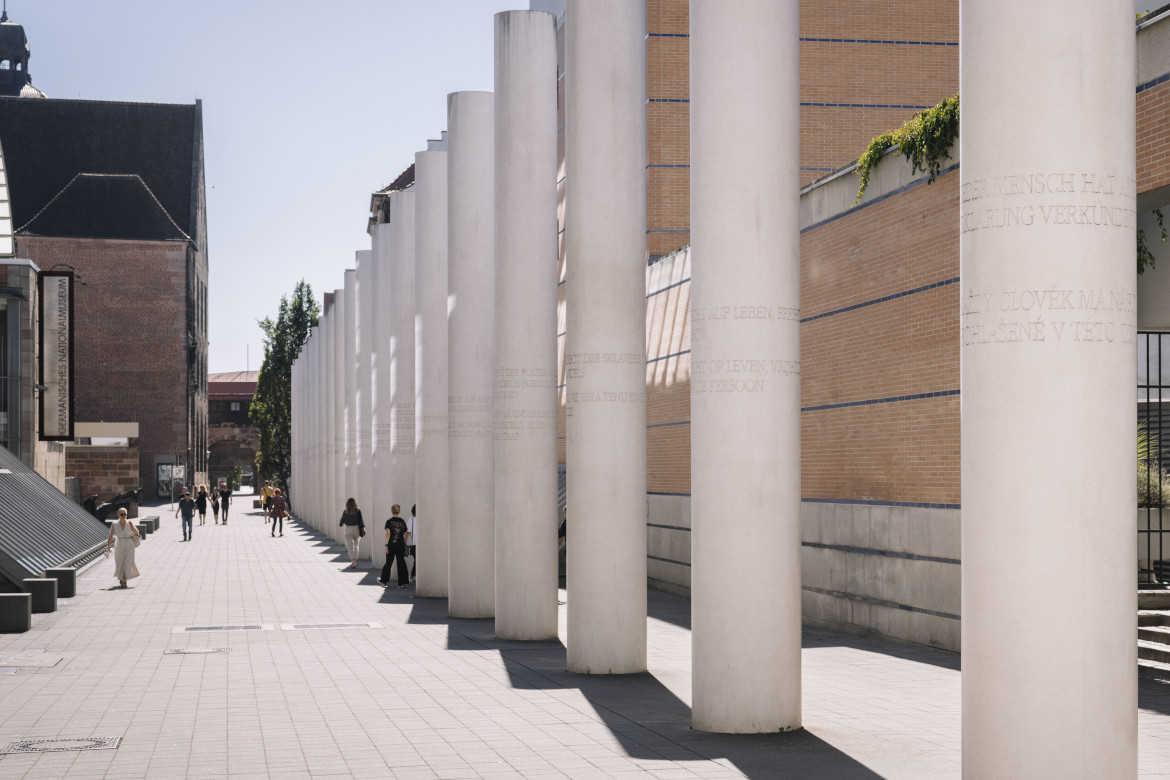
Part of the cluster’s program is to create outstanding programs for early-career researchers and international fellows, inviting young human rights researchers to practice at FAU in Nuremberg, the City of Human Rights.
Take the concrete example of workers in South Asian garment factories. In addition to the violations of labor rights that they may experience in global value chains, they also face climate-induced harms such as extreme heat.
Are existing human rights norms capable of responding to these overlapping harms? By rethinking how human rights and temporality interact, Caroline’s project hopes, for example, to reconceptualize the obligations placed on Transnational Corporate Actors. In addition, she will analyze how effective mechanisms such as Germany’s Lieferkettengesetz or the EU’s recently adopted Corporate Sustainability Due Diligence Directive (EU CSDDD) are responding to megatrends such as planetary environmental crises and increasingly fragmented economic globalization.
Adopting temporality as an analytical lens thus has the potential to reconfigure core human rights principles by expanding the scope of obligations beyond the here-and-now. As Caroline states, existing human rights seem to have a very particular linear conception of time which makes it difficult to respond effectively to violations experienced by rightsholders.
Her project intends to center other conceptions of time into normative debates surrounding human rights. For example, subjective temporality focuses on how rightsholders subjectively perceive violations of human rights, while neoliberal temporality allows us to see how neoliberalism contributes to precarity and instability by assigning absolute importance to economic value, thus negatively impacting the working conditions of individuals and communities.
Innovating Research in Human Rights
Research is not all the young scientist is responsible for in her new position. Part of her work description concerns academic work for the recently established Research Innovation Hub of the cluster. As the hub’s name indicates, a central objective is to rethink methodology, with a particular focus on innovative human rights research methods such as transdisciplinarity. They will also develop new theoretical frameworks for understanding and analyzing the role of human rights across different disciplines, including social sciences and philosophy.
Furthermore, the hub will advance dialogue between disciplines by organizing interdisciplinary workshops on methodology, and support the development and training of relevant research competences.
Together with the principal investigators, Prof. Dr. Almut Schilling-Vacaflor and Prof. Dr. Erasmus Mayr, Caroline will organize workshops (for example, methods-training labs), and lecture series on general theoretical megatrends. The team is also planning to invite external human rights experts to FAU and establish collaborations with other research clusters.
The Excellence Strategy
The Excellence Strategy is Germany's flagship program for promoting world-class research at its universities. Initiated by the German federal and state governments, the program has an annual budget of €687 Mio. It supports institutional strenghtening and enhances the international competitiveness of outstanding universities and research clusters.
Clusters of Excellence receive generous funding over a period of seven years, with the possibility of extension. This enables interdisciplinary teams to pursue a joint research agenda, and supporting early-career researchers on a large scale, while also facilitating international collaboration.
More about the 12 Clusters of Excellence at Bavarian Universities
Linking Academia and Society
While students and researchers are evidently part of the target group of such events, Caroline is determined to break the boundary between the world of academia and society. It is for this exact reason that the mentioned lecture series are open to interested members of the public. "Human rights are not meant as an academic conversation," she says. "They are a societal one."
Beyond academia, Caroline enjoys the experiences Bavaria has in store for her. She shares: "I recommend other international scientists coming here be open to new experiences, new languages, new culture. Be open to everything and let life surprise you."
