



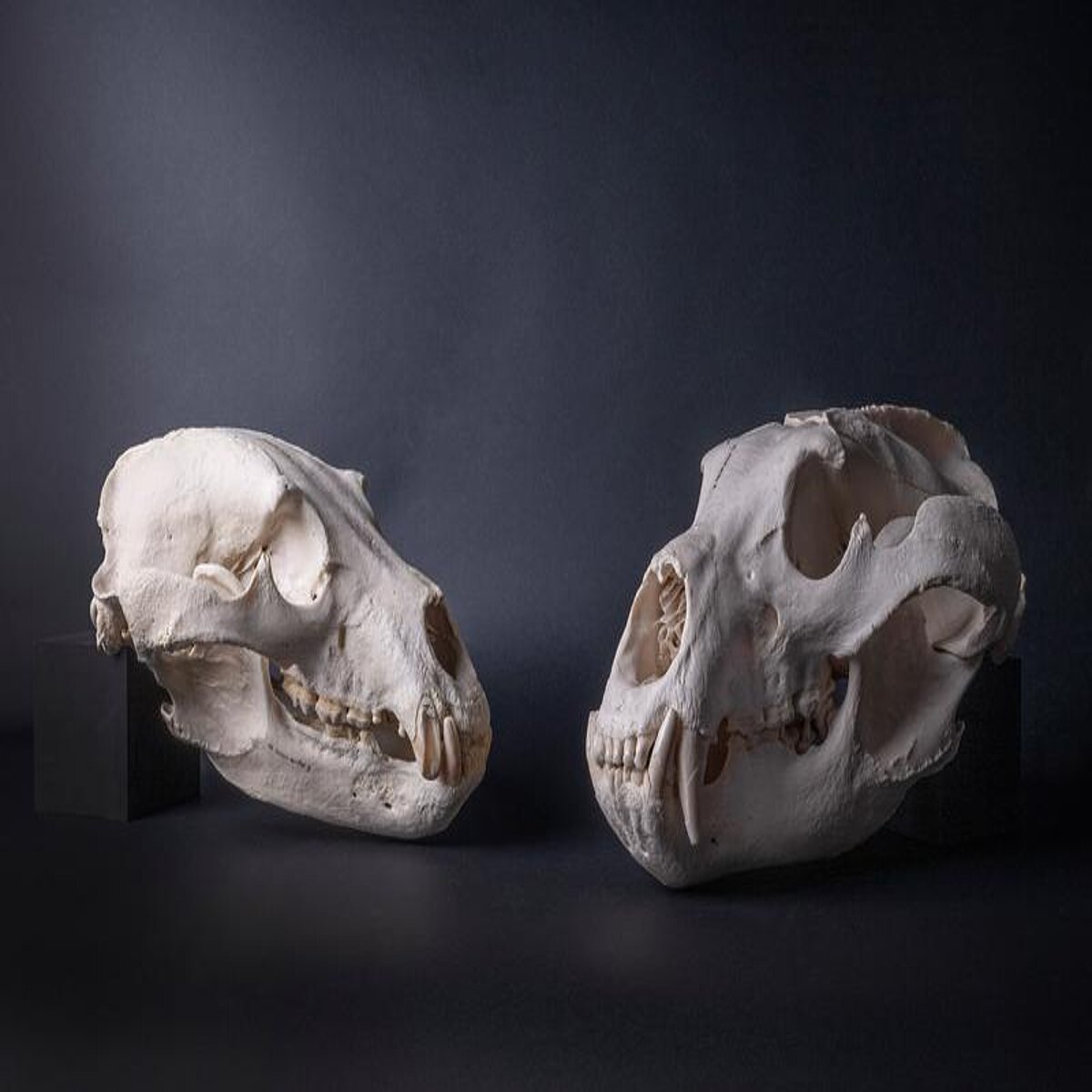
Skulls of brown bears from the SNSB’s paleoanatomical collection. On the right is a Syrian brown bear Ursus arctos syriacus, a subspecies adapted to warmer climates. K. Hagemann, SNSB
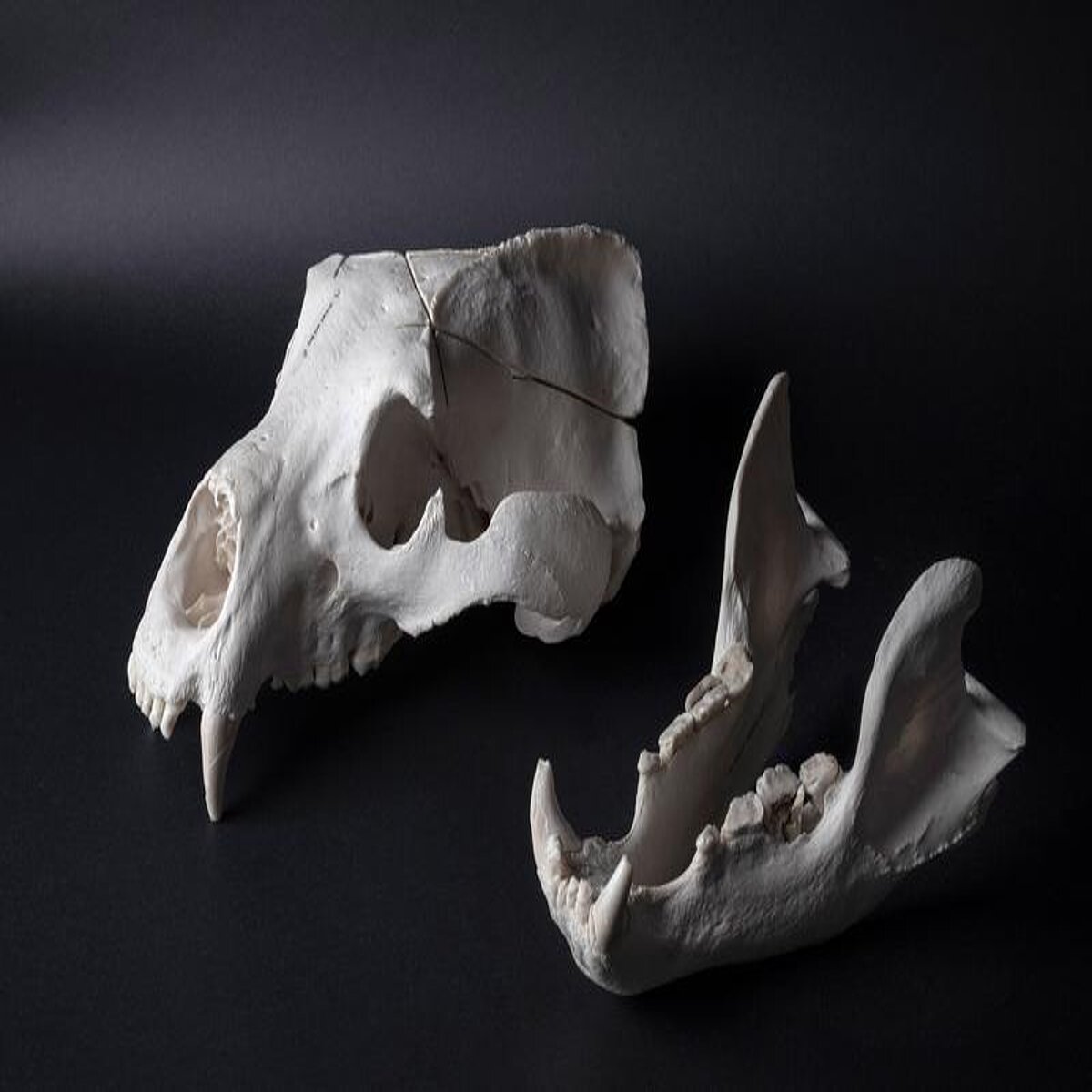
Lower jaw and skull bone of a Syrian brown bear Ursus arctos syriacus, a subspecies of the brown bear adapted to warmer climates, from the paleoanatomical collection of the SNSB. K. Hagemann, SNSB
Brown bears have lived in Europe for 175.000 years, right up to the present day. A new study now shows that, over the course of their evolution, the masticatory function of the lower jaws of European brown bears (Ursus arctos arctos) changed significantly time and again and did so in sync with the climate, alternating between warm and cold periods. This is the conclusion reached by zoologist Anneke van Heteren of the Bavarian State Collections of Natural History (SNSB) and her colleague from the Universidad del País Vasco, Donostia-San Sebastián. In their study, the two researchers compared the lower jaws of fossil and modern brown bears with those of their closest relatives, including two extinct cave bear species (Ursus spelaeus and Ursus deningeri) as well as polar bears (Ursus maritimus).
Detailed geometric 3D analyses show that the basic jaw structurehas remained remarkably stable in European brown bears over thousands of years. In contrast to the specialized herbivorous cave bear or the carnivorous polar bear, the brown bear retained a versatile, omnivorous jaw structure. This has not changed drastically since the Pleistocene. The crucial flexibility, however, lies in the details: The researchers found subtle differences in lower jaw morphology in the area where the large chewing muscle, Musculus masseter, attaches. Here, the morphology of brown bears varies over the course of their evolution, depending on whether they lived during warm or cold climatic periods. The lower jaws of fossil brown bears from cold periods resemble those of modern bears native to cooler regions of the Northern Hemisphere and high-altitude areas. The jaws of fossil brown bears from warm periods, regardless of geological age, differ significantly from these. Apparently, changes in the available food supply for brown bears were reflected in the flexible adaptation of their masticatory musculature.
“This morphological flexibility of the masticatory structures in brown bears shows us that the animals were evidently able to adapt optimally to the selective demands of their environment. Their ability to cope with such extreme climatic fluctuations likely played a decisive role in their evolutionary success. Brown bears have been continuously present in Europe since the Middle Pleistocene. More specialized species, such as the cave bear, however, became extinct,” explains Anneke van Heteren, curator of mammals at the Bavarian State Collections of Natural History (SNSB) and lead author of the study.
Contact for scientific information:
PD Dr. Anneke van Heteren
SNSB – Zoologische Staatssammlung München
Tel.: +49 89 8107 125
E-Mail: vanheteren@snsb.de
Original publication:
van Heteren A. H. & Villalba de Alvarado M. 2026. — Functional morphology of Pleistocene and Holocene brown bears (Ursus arctos Linnaeus, 1758): a 3D geometric morphometric approach to masse-ter biomechanics and evolutionary ecology. Comptes Rendus Palevol 25 (11): 189-205. https://doi.org/10.5852/cr-palevol2026v25a11
