



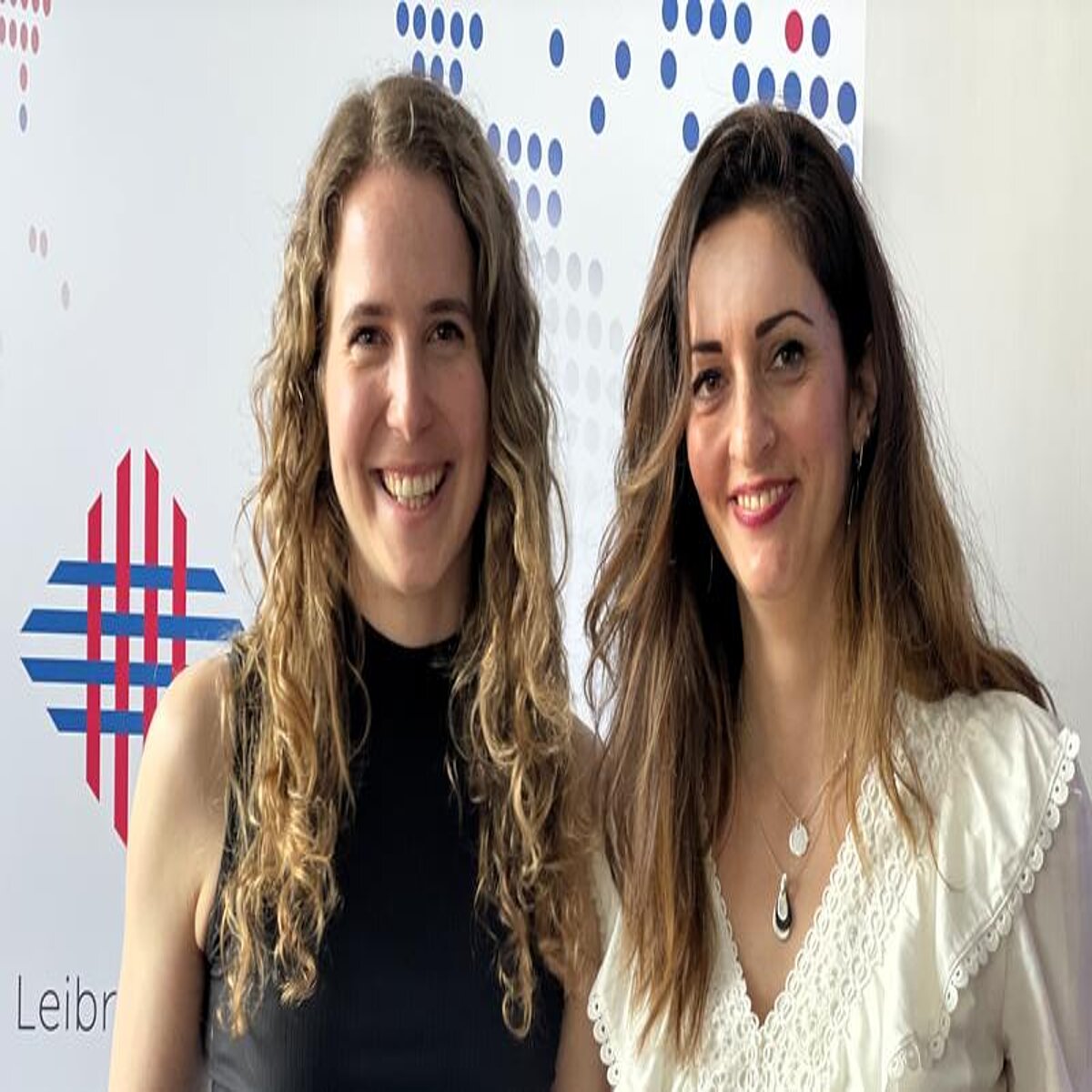
Spokespersons of the Law & Borders Research Network, Dr Marie Beyrich (l.) and Dr Mélanie Sadozaï. Tanja Wagensohn, University of Regensburg
The Leibniz ScienceCampus “Europe and America in the Modern World”, a joint platform of the University of Regensburg (UR) and the Regensburg Leibniz Institute for East and Southeast European Studies (IOS), is inter alia supporting innovative, multidisciplinary early career research. The most recent “Law & Borders Research Network” features scholars with backgrounds in law and border studies.
Network spokespersons Dr Marie Beyrich (Faculty of Law, University of Regensburg) and Dr Mélanie Sadozaï (DIMAS, University of Regensburg) welcomed over 50 people to an interactive and engaging launch event in Regensburg on June 11.
Early career researchers participating are
- Dr Ariane Bachelet, University of Paris 1, France
- Karst Berkenbosch, University of Leuven, Belgium
- Felix Bruckner, Center for Commemorative Culture, University of Regensburg, Germany
- Laura Amy Disley, Queen Mary University, London, UK
- Paschalina Garidou, Radboud University, Netherlands
- Dr Niamh Keady-Tabbal, Maynooth University, Ireland
- Luuk Winkelmolen, Radboud University, Netherlands
The guiding idea of the project is that law does not only draw borders on paper. It shapes and regulates them, creating thresholds that complicate the lives of those who cross or live alongside them. Borders, in this sense, are not static lines but shifting legal constructs that affect who may move, under what conditions, and with what consequences.
The Networks’s Focus Areas will be the Bavarian / Bohemian border, the Channel Islands, and Georgia / Abkhazia.
The launch event began with opening remarks by Professor Dr. Anne Brüske (LSC Board of Directors, University of Regensburg) and Dr. Paul Vickers (LSC Manager). This was followed by an inspiring keynote address by Professor Dr. Henk van Houtum (Radboud University, Nijmegen), titled "Between Monad and Nomad: Law, Bordering, and Lines of Flight.” Professor van Houtum also participated in a discussion titled "What Do Law and Border Studies Have to Say?" featuring Professor Tobias Eule (University of Bern) and journalist Jorie Horsthuis (Amsterdam), chaired by Professor Alexander Graser (University of Regensburg Faculty of Law).
Borders: From Lines on Paper to Everyday Realities
Traditionally, borders have been understood as political markers. However, critical border scholars have challenged this approach, drawing attention to borders’ lived dimensions. Nevertheless, this scholarship has only partially explored how legal frameworks set the conditions for who may cross, under which circumstances, and with what rights.
“In our work, we take law as the starting point of everyday life. Borders matter for people: they take shape in regular encounters, in access to work or welfare, and in local memories of past divisions”, Marie Beyrich and Mélanie Sadozaï explain. “Geography, politics, and culture continue to play a crucial role, but law now often provides the decisive framework through which these other factors are channelled and made tangible.”
The early career researcher’s method is the Border Lab: It involves immersive, field-based encounters in regions where law, politics, and everyday life collide in distinctive ways.
The Leibniz ScienceCampus will support the network until 2028.
Contact for scientific information:
Dr. Marie Beyrich marie.beyrich@ur.de
Dr. Mélanie Sadozaï melanie.sadozai@ur.de
